
What Is Urolithin A? Benefits, Food Sources, and How It Supports Mitochondrial Health
You may have noticed Urolithin A appearing in conversations about mitochondrial health, cellular energy, muscle function, and healthy aging. Unlike familiar nutrients such as vitamin D or magnesium, however, Urolithin A is not something most people immediately recognize.
So, what exactly is it?
Urolithin A is a compound connected to certain polyphenol-rich foods, the bacteria living in your digestive system, and a cellular maintenance process known as mitophagy. Researchers are studying it for its potential role in supporting mitochondrial quality and physical function as we age.
The science is promising, but the story is often oversimplified. Eating a pomegranate does not automatically mean that your body will produce a predictable amount of Urolithin A, and taking a supplement should not be viewed as a shortcut to reversing aging.
Here is what we currently know.
What Is Urolithin A?
Urolithin A is a metabolite, meaning it is a substance created when another compound is processed by the body.
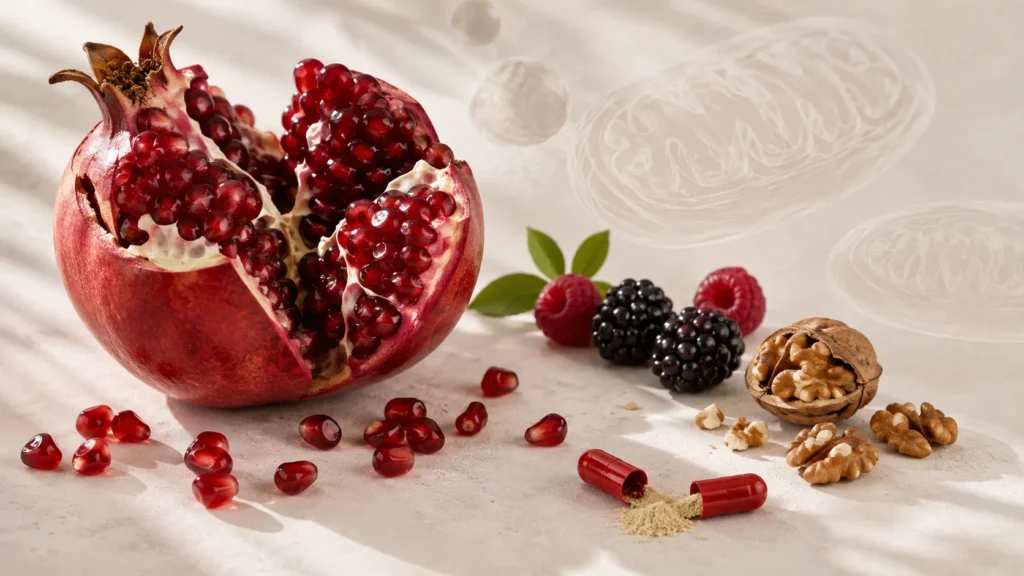
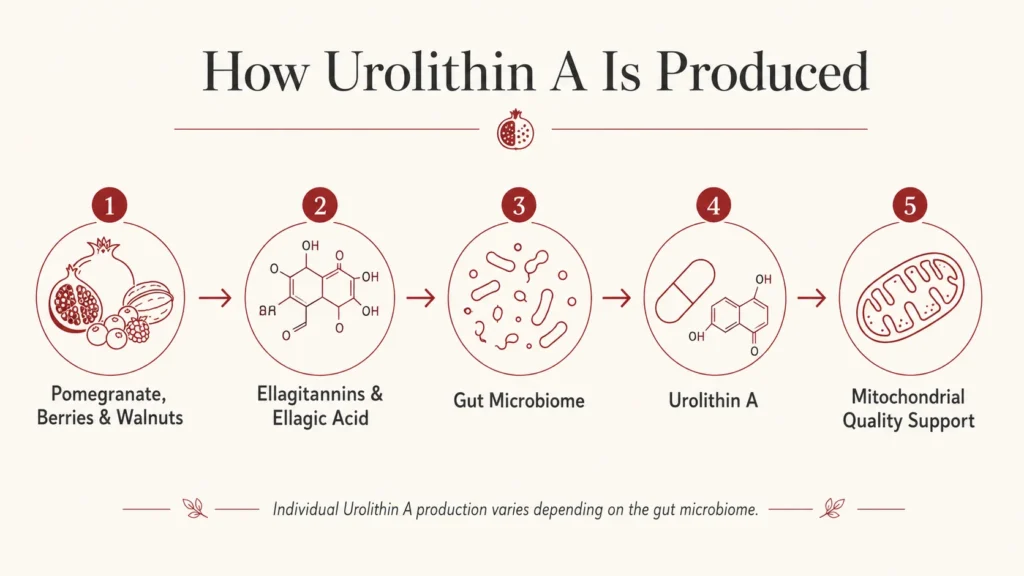
In this case, the process begins with plant compounds called ellagitannins and ellagic acid. These polyphenols occur naturally in foods such as:
- Pomegranates
- Walnuts
- Raspberries
- Blackberries
- Strawberries
- Muscadine grapes
After these foods are eaten, certain gut bacteria can transform their ellagitannins and ellagic acid into compounds called urolithins. Urolithin A is one of the primary urolithins studied in humans. Urolithins are generally more readily absorbed than the original ellagitannins from which they are produced.
This makes Urolithin A especially interesting: its production depends not only on what you eat, but also on the composition of your gut microbiome.
Want to go deeper into how Urolithin A relates to mitochondrial quality and cellular energy? Read our guide to Urolithin A and Mitochondrial Health.
Can Everyone Produce Urolithin A Naturally?
Not necessarily.
People have different communities of bacteria in their digestive systems. As a result, two people may eat the same amount of pomegranate or walnuts but produce very different amounts and types of urolithins.
Researchers describe these differences using urolithin metabotypes. Some individuals produce Urolithin A efficiently, while others produce different urolithins or little measurable Urolithin A. Studies examining direct supplementation have found that providing Urolithin A bypasses this variability in gut conversion.
This does not make pomegranates or berries less valuable. These foods contain fiber, vitamins, minerals, and a wide variety of plant compounds that contribute to a balanced diet.
It simply means that eating an ellagitannin-rich food is not the same as receiving a standardized amount of Urolithin A.
Why Are Mitochondria So Important?
Mitochondria are small structures inside most of your cells. They are often called the “powerhouses of the cell” because they help turn nutrients into adenosine triphosphate, or ATP—the usable energy that supports cellular activity.
But mitochondria do more than produce energy. They also participate in:
- Cellular signaling
- Metabolic regulation
- Responses to physical stress
- Muscle activity
- The maintenance of normal cellular function
Like other parts of the body, mitochondria can become damaged or less efficient over time. Cells therefore need ways to identify and remove mitochondria that are no longer functioning properly.
One of those quality-control processes is called mitophagy.
What Is Mitophagy?
Mitophagy is a specialized form of autophagy, the process cells use to break down and recycle worn-out components.
You can think of mitophagy as a mitochondrial quality-control system. Instead of allowing dysfunctional mitochondria to accumulate, the cell identifies and removes them so that cellular resources can be used more efficiently.
Urolithin A has attracted scientific attention because preclinical and human research indicates that it can activate biological pathways associated with mitophagy. An early human study found that Urolithin A supplementation produced molecular signatures associated with improved mitochondrial and cellular health.
This does not mean Urolithin A literally “cleans,” “repairs,” or “replaces” mitochondria on demand. Those descriptions are popular online, but they make a complex biological process sound far more direct and predictable than it is.
A more accurate way to describe the research is that Urolithin A is being studied for its ability to support the body’s natural mitochondrial quality-control processes.
What Are the Potential Benefits of Urolithin A?
Research on Urolithin A is still developing. Most of the human evidence currently centers on mitochondrial biomarkers, muscle endurance, muscle strength, physical performance, and healthy aging.
1. Mitochondrial health
Urolithin A’s best-known area of research is mitochondrial quality.
In human trials, supplementation has been associated with changes in biomarkers and gene-expression patterns related to mitochondrial health, fatty-acid oxidation, autophagy, and cellular metabolism. These findings help explain why Urolithin A is increasingly included in the mitochondrial supplement category.
It is important to distinguish biomarkers from everyday outcomes. A favorable change in a biological marker does not guarantee that every person will notice more energy or feel physically different.
2. Cellular energy support
Because mitochondria help cells produce ATP, mitochondrial quality is closely connected to normal cellular energy production.
However, “cellular energy” should not be confused with the immediate alertness people may experience from caffeine. Urolithin A is not a stimulant. Its research focuses on the underlying processes involved in mitochondrial and cellular function rather than a rapid energy boost.
For consumers, this distinction matters. A mitochondrial supplement is generally intended to complement a consistent wellness routine, not act like coffee or a pre-workout product.
3. Muscle function and endurance
Muscle tissue has high energy demands and contains many mitochondria. For this reason, researchers have studied whether supporting mitochondrial quality may also support physical function.
In a randomized clinical trial involving older adults, Urolithin A supplementation was well tolerated and was associated with improvements in certain measures of muscle endurance, although not every primary outcome showed a statistically significant difference compared with placebo.
Another randomized trial in middle-aged adults reported improvements in measures of muscle strength, exercise performance, and biomarkers of mitochondrial health.
These results are encouraging, but they should not be interpreted as proof that Urolithin A builds muscle or replaces exercise. Resistance training, adequate protein, regular movement, sleep, and overall nutrition remain central to maintaining muscle health.
4. Healthy aging
Interest in Urolithin A is often connected to longevity, but healthy aging is the more useful way to understand its role.
Longevity is not simply about adding years to life. For many adults, the practical goal is to maintain:
- Energy for everyday activities
- Muscle function and mobility
- Physical independence
- The ability to exercise and recover
- A consistent sense of vitality
Mitochondrial quality and muscle function are both relevant to these goals. That is why Urolithin A is being studied within the wider field of healthy aging.
Still, no supplement has been shown to stop aging, reverse aging, or guarantee a longer life. Urolithin A should be viewed as one possible part of a broader healthy-aging routine—not as a stand-alone longevity solution.
Can You Get Urolithin A from Food?
You can support your body’s natural production of urolithins by eating foods rich in ellagitannins and ellagic acid.
Pomegranates are the best-known source, but walnuts and several berries also contain these compounds. Your gut bacteria must then convert them into Urolithin A.
That conversion is where individual variation becomes important.
Some people may be efficient Urolithin A producers. Others may produce smaller amounts or different urolithins. Direct supplementation provides Urolithin A itself rather than relying on the microbiome to complete the conversion.
Food and supplements therefore serve different purposes:
Whole foods provide a complex combination of fiber, micronutrients, and phytonutrients.
Urolithin A supplements provide a measured amount of one specific metabolite.
They do not need to be viewed as competitors. A supplement can complement a nutrient-rich diet, but it cannot recreate everything provided by whole foods.
How Much Urolithin A Has Been Studied?
Human studies have evaluated a range of daily amounts. A 2024 systematic review of five studies involving approximately 250 healthy participants reported daily amounts ranging from 10mg to 1000mg, with study periods lasting from 28 days to four months.
The fact that a dose has been used in research does not automatically make it the ideal amount for every individual. Study populations, objectives, duration, formulations, and measured outcomes can all differ.
When comparing products, check whether the amount is listed:
- Per capsule
- Per serving
- Per daily dose
For example, a bottle may display “1000mg” prominently while requiring two or more capsules to provide that amount. The Supplement Facts panel should make the serving size clear.
What Should You Look for in a Urolithin A Supplement?
A good label should make it easy to understand what you are purchasing.
Look for:
A clearly stated amount
The label should identify how much Urolithin A is provided per serving—not simply the total weight of an ingredient blend.
A transparent serving size
Check how many capsules are required and how many servings the bottle contains.
A straightforward formula
Some consumers prefer a single-ingredient Urolithin A formula because it allows them to evaluate the ingredient and dose without a long list of unrelated active compounds.
Third-party testing
Testing can provide additional assurance that a product meets defined standards for identity, purity, and quality. Brands should be able to support testing and manufacturing claims with appropriate documentation.
Responsible language
Be cautious of products promising to reverse aging, repair every damaged mitochondrion, prevent disease, or produce guaranteed results. Credible supplement companies should communicate both the potential and the limitations of current research.
Who May Be Interested in Urolithin A?
Urolithin A may appeal to adults who are interested in:
- Mitochondrial and cellular wellness
- Maintaining muscle function with age
- Supporting an active lifestyle
- Healthy-aging nutrition
- Transparent, single-ingredient supplements
- Building a consistent long-term wellness routine
Pregnant or nursing individuals, people taking medication, and anyone managing a medical condition should speak with a qualified healthcare professional before adding a new dietary supplement.
The Bottom Line
Urolithin A is a gut-derived metabolite connected to pomegranates, walnuts, berries, and other foods containing ellagitannins. Its production varies from person to person because it depends on the gut microbiome.
What makes Urolithin A noteworthy is its relationship with mitophagy—the cellular process involved in identifying and recycling damaged mitochondria. Human research has explored its effects on mitochondrial biomarkers, muscle endurance, strength, and physical function, with promising but still developing results.
Urolithin A is not a stimulant, an anti-aging cure, or a substitute for exercise and good nutrition. It is better understood as a targeted nutritional compound that may complement a lifestyle built around movement, balanced meals, adequate sleep, and healthy daily habits.
For adults interested in mitochondrial supplements, the best approach is to look beyond bold front-label promises. Pay attention to the actual amount per serving, formula transparency, quality testing, and whether the brand communicates the research responsibly.
BioFianne Urolithin A Supplement provides 1000mg per 2-capsule serving in a straightforward, single-ingredient formula. Each bottle contains 60 vegan capsules and provides 30 daily servings.
These statements have not been evaluated by the Food and Drug Administration. This product is not intended to diagnose, treat, cure, or prevent any disease.