
Urolithin A and Mitochondrial Health: What Cellular Energy Really Means
Urolithin A and Mitochondrial Health: What Cellular Energy Really Means
If you spend any time reading about healthy aging, performance, or longevity, you have probably come across the phrase “mitochondrial health.”
It sounds scientific—and it is—but the basic idea is surprisingly practical.
Mitochondria help your cells produce the energy needed for movement, muscle function, metabolism, and everyday activity. Like other parts of the body, however, they do not stay equally efficient forever. Cells rely on built-in quality-control systems to identify and recycle mitochondria that are no longer working as well as they should.
That is where Urolithin A has become interesting to researchers.
Urolithin A is a gut-derived metabolite that has been studied for its role in mitophagy, a natural cellular process involved in mitochondrial quality control. Human research has also explored its effects on mitochondrial biomarkers, muscle endurance, physical function, and healthy aging.
But what does all of that actually mean in everyday terms?
First, What Do Mitochondria Actually Do?
Mitochondria are tiny structures found inside most of your cells.
Their best-known job is helping convert nutrients from food into ATP, or adenosine triphosphate. ATP is the form of energy cells can actually use.
That energy supports everything from walking up the stairs to contracting a muscle to maintaining normal cellular activity.
This is why mitochondria are often called the “powerhouses of the cell.”
The phrase is useful, but it can also be misleading. Mitochondria are not simply miniature batteries. They are active participants in a much larger network involved in metabolism, cellular signaling, stress responses, and normal tissue function.
Muscle cells, in particular, depend heavily on healthy mitochondria because movement requires a continuous supply of energy.
What Happens to Mitochondria as We Age?
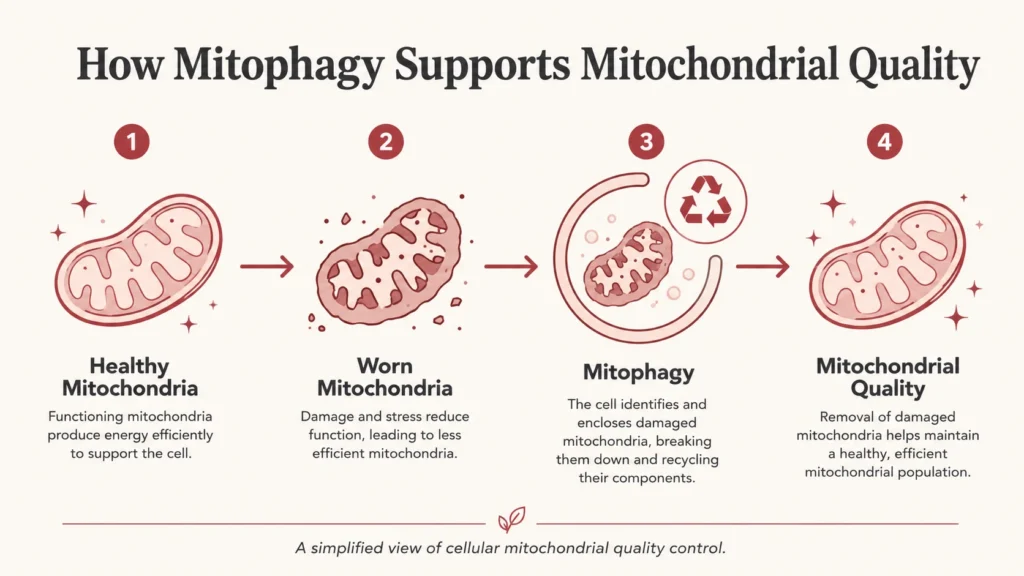
Aging is associated with changes in mitochondrial number, efficiency, and quality.
Over time, mitochondria can become less effective at producing energy, while damaged or dysfunctional mitochondria may accumulate if cellular cleanup systems become less efficient.
This does not mean that everyone suddenly “runs out of energy” at a certain age.
Instead, the changes tend to happen gradually and can interact with many other factors, including:
- Physical activity
- Muscle mass
- Sleep
- Nutrition
- Metabolic health
- Genetics
- Overall lifestyle
This is one reason researchers increasingly look at mitochondrial quality as part of the broader healthy-aging picture.
What Is Mitophagy?
Mitophagy is a specialized form of autophagy.
Autophagy is the process cells use to break down and recycle old or damaged components. Mitophagy specifically refers to the removal of mitochondria that are no longer functioning properly.
A simple way to think about it is:
Mitochondria produce energy. Mitophagy helps maintain mitochondrial quality.
Cells continually balance the creation, maintenance, and removal of mitochondria. When that quality-control system works well, cells are better able to maintain a healthier mitochondrial population.
Urolithin A has attracted attention because preclinical research identified it as a compound capable of activating pathways associated with mitophagy.
In a first-in-human study published in Nature Metabolism, researchers found that daily Urolithin A supplementation at 500mg and 1000mg for four weeks affected plasma metabolites and skeletal-muscle gene expression associated with mitochondrial function.
That does not mean Urolithin A literally “cleans out” damaged mitochondria overnight.
It means researchers observed biological changes consistent with improved mitochondrial and cellular health.
Where Does Urolithin A Come From?
Urolithin A has an unusual origin.
Your body does not simply absorb large amounts of it directly from common foods.
Instead, certain foods contain compounds called ellagitannins and ellagic acid. These compounds are found in foods such as:
- Pomegranates
- Walnuts
- Raspberries
- Blackberries
- Strawberries
Certain gut bacteria can convert these compounds into urolithins, including Urolithin A.
The catch is that not everyone has the same gut microbiome.
This means two people can eat the same pomegranate and produce different amounts of Urolithin A.
That is one reason direct Urolithin A supplementation has become an area of interest: it provides a defined amount of the metabolite without depending entirely on gut conversion.
If you want a deeper explanation of this process, read our guide: What Is Urolithin A? Benefits, Food Sources, and How It Works.
Cellular Energy Does Not Mean “Instant Energy”
This is one of the most important distinctions to understand.
When a supplement is described as supporting cellular energy, that does not mean it should feel like coffee, an energy drink, or a pre-workout.
Caffeine works primarily by affecting the nervous system and temporarily reducing the perception of fatigue.
Mitochondrial support is a different concept.
Mitochondria are involved in the cellular processes that produce ATP. Supporting mitochondrial quality is therefore more about the underlying machinery of cellular energy production—not delivering an immediate burst of alertness.
So if someone takes Urolithin A and expects to feel noticeably “energized” 30 minutes later, that expectation does not match how the ingredient has been studied.
Urolithin A is better understood as part of a consistent, long-term wellness routine.
What Does Human Research Say About Urolithin A?
Human research is still relatively limited compared with older nutrients such as creatine, vitamin D, or magnesium.
However, several clinical studies have produced interesting results.
Study 1: Mitochondrial biomarkers
A 2019 first-in-human study evaluated Urolithin A in healthy older adults.
After four weeks, researchers reported that 500mg and 1000mg daily doses influenced biomarkers and gene-expression patterns associated with mitochondrial and cellular health.
The study was primarily designed to evaluate safety and biological activity, not whether participants would visibly feel younger or more energetic.
That distinction matters.
Study 2: Muscle endurance in older adults
A randomized clinical trial published in JAMA Network Open included 66 adults aged 65 to 90.
Participants received either 1000mg of Urolithin A daily or placebo for four months.
At two months, the Urolithin A group showed significant improvements in muscle endurance in both hand and leg muscles compared with placebo. Researchers also observed changes in several blood biomarkers associated with mitochondrial health.
However, the trial did not find a statistically significant difference between groups for two of its primary outcomes: six-minute walking distance and maximal ATP production in the hand muscle.
That is a useful example of why supplement research should be read carefully.
The results were encouraging—but they were not uniformly positive across every measurement.
What Does This Mean for Muscle Function?
Muscle tissue is especially dependent on mitochondria.
Every muscle contraction requires energy, which is why researchers are interested in the relationship between mitochondrial quality and muscle function as people age.
This also explains why Urolithin A is often positioned differently from traditional sports supplements.
Creatine, for example, is commonly associated with strength and high-intensity performance.
Protein supports muscle protein synthesis.
Urolithin A has a different research story: mitochondrial quality, cellular energy, and muscle function.
That makes it relevant not only to athletes, but also to adults interested in maintaining movement, endurance, and physical capability over time.
Is Urolithin A a Longevity Supplement?
You will often see Urolithin A grouped with longevity supplements.
That category may also include compounds such as:
- NMN
- NR
- CoQ10
- PQQ
- Spermidine
- Resveratrol
But “longevity” can mean very different things depending on how the term is used.
There is currently no evidence that taking Urolithin A guarantees a longer lifespan in humans.
A more grounded way to think about it is healthspan—the years of life spent with good physical function, energy, mobility, and independence.
From that perspective, mitochondrial health and muscle function make sense as areas of interest.
Urolithin A belongs in the healthy-aging conversation because researchers are studying biological systems that influence how well cells and muscles function over time—not because it has been proven to extend human life.
Can Exercise Support Mitochondrial Health Too?
Absolutely.
Exercise is one of the most established ways to support mitochondrial health.
Both endurance exercise and resistance training can stimulate adaptations in muscle that improve mitochondrial number, efficiency, and metabolic function.
Regular movement also supports:
- Muscle strength
- Cardiovascular health
- Insulin sensitivity
- Mobility
- Physical independence
This is why mitochondrial supplements should never be viewed as substitutes for exercise.
The stronger approach is complementary:
Exercise provides the stimulus. Nutrition provides the building blocks. Sleep supports recovery. Supplements may provide additional targeted support.
That is a much more realistic healthy-aging strategy than trying to find a single “longevity molecule.”
What Else Supports Mitochondrial Health?
You do not need an extreme biohacking routine to support mitochondrial wellness.
The fundamentals still matter most:
Move regularly
Walking, resistance training, cycling, swimming, and other forms of consistent exercise all help maintain metabolic and muscular health.
Eat enough protein
Protein provides amino acids needed to maintain muscle tissue, especially as we age.
Prioritize sleep
Poor sleep affects metabolism, recovery, and physical performance.
Eat a varied diet
Whole foods provide vitamins, minerals, polyphenols, healthy fats, and other nutrients involved in cellular metabolism.
Avoid relying on supplements alone
No mitochondrial supplement can compensate for chronic inactivity, poor nutrition, or consistently inadequate sleep.
That may sound less exciting than a “biohacking stack,” but it is far more practical.
How Is Urolithin A Different From Other Mitochondrial Supplements?
Not all mitochondrial supplements work through the same pathway.
For example:
CoQ10 is involved in the mitochondrial electron transport chain.
NAD+ precursors such as NR and NMN are intended to support NAD+ metabolism.
PQQ is commonly discussed in relation to mitochondrial signaling and biogenesis.
Urolithin A is studied primarily for its relationship with mitophagy and mitochondrial quality control.
This does not necessarily make one ingredient “better” than another.
They are simply associated with different biological pathways.
For consumers comparing mitochondrial supplements, the better question is often:
What pathway am I actually trying to support?
Should You Choose a Single-Ingredient Urolithin A Formula?
There are two common approaches on the market.
Some products combine Urolithin A with several other healthy-aging ingredients.
Others use a single-ingredient formula.
A combination product can be convenient for someone who wants several ingredients in one routine.
A single-ingredient formula can be useful for people who:
- Want to know exactly how much Urolithin A they are taking
- Prefer simpler supplement routines
- Already take other mitochondrial or longevity supplements
- Want to evaluate one ingredient at a time
- Prefer to avoid large proprietary blends
Neither format is automatically superior.
Transparency matters more than ingredient count.
The Bottom Line
Mitochondrial health has become a major topic in healthy-aging research because mitochondria are central to cellular energy, muscle function, and everyday physical activity.
Urolithin A is interesting because it is being studied for its relationship with mitophagy, the natural process cells use to maintain mitochondrial quality.
Human studies have found changes in mitochondrial biomarkers and, in some trials, improvements in muscle endurance. At the same time, not every outcome has shown a significant benefit, and the research is still developing.
That makes Urolithin A promising—but not magical.
The most practical way to think about mitochondrial health is not as a single supplement strategy, but as part of a broader system built around regular movement, resistance training, nutritious food, quality sleep, and consistent habits.
For adults exploring mitochondrial supplements, Urolithin A offers a distinctive approach centered on mitochondrial quality rather than immediate stimulation.
These statements have not been evaluated by the Food and Drug Administration. This product is not intended to diagnose, treat, cure, or prevent any disease.
Sources & References
This article is based on peer-reviewed human research and established scientific literature on Urolithin A, mitochondrial health, mitophagy, and muscle function.
Andreux PA, Blanco-Bose W, Ryu D, et al.
The mitophagy activator urolithin A is safe and induces a molecular signature of improved mitochondrial and cellular health in humans.
Nature Metabolism. 2019;1:595–603.
This first-in-human study evaluated the safety and biological activity of Urolithin A and reported molecular changes associated with mitochondrial and cellular health.Liu S, D’Amico D, Shankland E, et al.
Effect of Urolithin A Supplementation on Muscle Endurance and Mitochondrial Health in Older Adults: A Randomized Clinical Trial.
JAMA Network Open. 2022;5(1):e2144279.
This randomized, placebo-controlled trial evaluated 1000mg of Urolithin A daily for four months in adults aged 65–90, including outcomes related to muscle endurance, physical function, ATP production, and mitochondrial health biomarkers.